
Posted October 16, 2026

By Emily Clancy
Bethlehem Steel’s Birthright
My dad helped build an oven at Bethlehem Steel.
On one of the last major projects at the Sparrows Point mill in Maryland, his crew worked 12-hour shifts, seven days a week, to meet a deadline.
Thanksgiving was approaching, and several of the men had traveled from out of town. They wouldn’t be home for the holiday.
So the electricians and welders decided to bring Thanksgiving to the job site.
They bought a turkey and all the fixings, then built the oven to cook it. By 6 a.m. on Thanksgiving morning, the bird was roasting.
Soon, the unmistakable aroma of Thanksgiving dinner filled the building. The men enjoyed a holiday meal, right there in the middle of Bethlehem Steel.
My dad was an IBEW electrician who worked at Bethlehem Steel on and off for about 10 years. As an outside contractor, he moved from one project to the next.
At its peak, Bethlehem Steel’s Sparrows Point mill employed around 30,000 people. It was one of the largest steelmaking operations in the world, producing steel for American buildings, bridges, automobiles and ships.
For generations, the mill provided a path to the middle class.
A high school diploma and a willingness to learn a trade could lead to a good-paying job, a house, a family and maybe even a vacation home down at the shore.
And those paychecks supported far more than the workers themselves. Local businesses prospered, neighborhoods grew and families put down roots in communities built around the mill.
But that economy gradually unraveled.
Foreign competition and decades of restructuring took their toll. Bethlehem Steel filed for bankruptcy in 2001, and steelmaking at Sparrows Point ended in 2012.
When the jobs disappeared, the loss extended well beyond the mill itself.
Your Rundown for Friday, October 16, 2026...
Sparrows Point Gets a Second Act
Now, more than a decade after steelmaking ended, Sparrows Point could be getting a remarkable second act.
On Oct. 6, President Trump visited the former Bethlehem Steel site to announce plans by Anduril Industries, a privately held defense technology company, to invest $3.7 billion in a new manufacturing complex.
Founded in 2017, Anduril is best known for developing military drones, autonomous weapons systems and advanced defense software. Now it’s preparing to tackle a different challenge.
Its proposed manufacturing complex, called Arsenal-2, would occupy approximately 187 acres at Sparrows Point, with more than 2 million square feet of manufacturing space and over 3,100 permanent jobs.
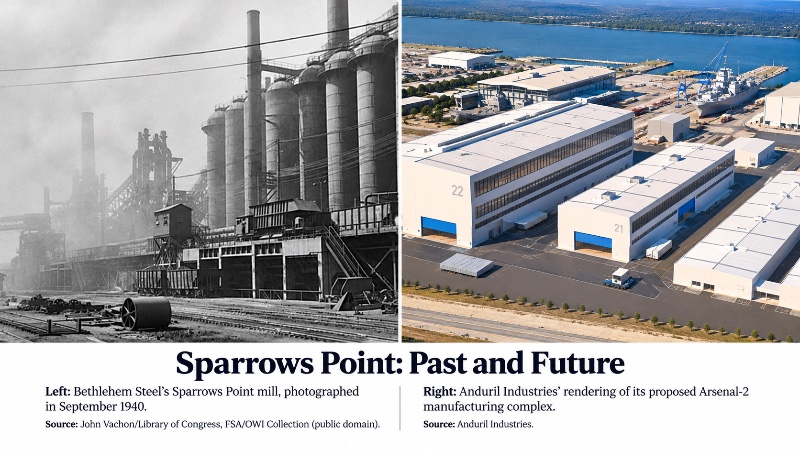
And there’s a compelling reason for the investment: The Navy needs to increase production of its Virginia-class nuclear-powered attack submarines.
American shipyards have been producing roughly 1.2 Virginia-class submarines annually, short of the Navy’s target of two per year.
Anduril plans to start by making torpedo tubes before expanding into larger submarine components, which established shipbuilders would assemble into finished vessels.
The $3.7 billion investment would come from Anduril’s own capital, while a separate Navy contract provides for payments of up to $2.9 billion tied to production milestones.
Trump also announced that the federal government would receive a 40% ownership stake in the new shipyard venture, although the financial terms have yet to be disclosed.
Anduril expects to begin operations at Sparrows Point in 2030. That’s still several years away, and the project must clear permitting, construction and workforce hurdles. State and local governments are also considering substantial tax breaks and other incentives, so the public cost deserves scrutiny.
Still, consider what this means for a site that once supplied steel for America’s industrial expansion. Sparrows Point could soon help produce the components needed to strengthen the U.S. Navy.
And the economic benefits could extend beyond national defense. The project would create demand for electricians, welders, machinists, engineers and the businesses that supply them. Those jobs, in turn, would support the surrounding communities.
For decades, American companies pursued lower production costs overseas, often at the expense of domestic manufacturing capacity. We’ve since learned how difficult it can be to rebuild an industry once its factories close.
America still has enormous natural resources, industrial infrastructure and manufacturing expertise. But those advantages mean little unless we put them to work.
I don’t expect Anduril to recreate the Bethlehem Steel my dad remembers.
Its proposed workforce is a fraction of the mill’s peak employment, and there’s a long way to go before the first submarine components roll out of Arsenal-2.
But there’s something encouraging about a former steel mill becoming part of America’s industrial future.
For another generation of skilled workers, it could mean the chance to earn a good living, buy a home and raise a family in the communities where they grew up.
That’s the opportunity my dad’s generation knew. And it’s one worth bringing back.
Market Rundown for Friday, Oct. 16, 2026
S&P 500 futures are up 0.12% to 7,800.
Oil is up slightly to $98.05 for a barrel of West Texas crude.
Gold’s up 0.60% to $4,196.80 per ounce.
And Bitcoin’s down to $82,245.

Ilhan Omar’s October Surprise
Posted October 14, 2026
By Matt Insley

The Most Important Rundown You’ll Read This Year
Posted October 12, 2026
By Matt Insley

No Gamble, No Future
Posted October 09, 2026
By Matt Insley

Bloodshed Draws Rubberneckers
Posted October 07, 2026
By Emily Clancy

After SaaS, Private Credit Bets on AI
Posted October 05, 2026
By Matt Insley
