
Posted May 03, 2023

By Matt Insley
Confused About Trading Options?
Another Sunday, another banking crisis.
Namely, San Francisco-based First Republic Bank became the second-largest bank failure in U.S. history (after Washington Mutual in 2008).
The government seized the infirm bank, turning most of it over to JP Morgan Chase.
So, if you have an account at a regional bank, how’d your bank fare last quarter?
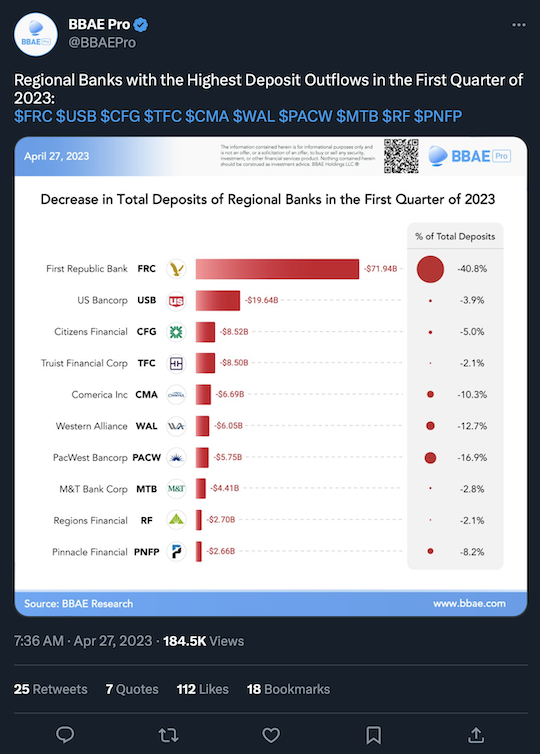
We’ll keep an eye on this situation.
But in the aftermath of First Republic’s failure, the FDIC “estimates that the cost to the Deposit Insurance Fund will be about $13 billion.
In the first quarter of 2023, then, the FDIC insurance took a $35.5-billion hit.
Scary times…
Send your opinions to, feedback@newsyoucanacton.com
Your Rundown for Wednesday, May 3, 2023...
Options-Trading Advice from a CBOE Veteran
We’re taking a bit of a detour today.
Since many Paradigm subscription trading services are options-based, I thought it would be worthwhile to outline a (hopefully) helpful primer.
For that, we turn to Paradigm editor Alan Knuckman, who’s traded options for more than a quarter century. “Before we get started,” he says, “I want to make sure we’re clear on a few basics.”
First, an options contract is a financial contract that gives the buyer the right — but not the obligation — to buy or sell a specific quantity of a security at a specific price on or before a specific date.
“Every options contract has a strike price,” Alan says, “The strike price is the price both parties agree to use when buying or selling the underlying stock.”
Here’s an example: “You buy a call option for Apple (APPL) with a strike price of $165. You can exercise that option and pay $165 for Apple’s stock — no matter what the price of the stock is.”
Good idea? That depends on the price of Apple shares when you exercise your option.
Obviously, if Apple shares are trading at $145 and you pay $165, that’s a bad deal. “Why would you voluntarily pay an extra $20 per share?” says Alan. “You wouldn’t!
“The relationship between the strike price and the underlying stock’s price is called moneyness.”
Alan continues: “When it doesn’t make sense to exercise the option, the contract is considered ‘out of the money.’ It’s called that because you end up paying more for the stock with the contract than without.
“But when it does make sense to exercise that option, like when Apple is trading above $180 and you can buy it for $165, then the contract is considered ‘in the money.’
“This distinction between ‘in the money’ and ‘out of the money’ is important because it’s where most options traders go wrong,” Alan says.
“The problem is ‘out of the money’ options are much cheaper than ‘in the money’options because they hardly ever payout,” Alan says.
“My friends on the trading floor of the Chicago Board Options Exchange (CBOE) called ‘out of the money’ options LOTTERY TICKETS.”
Alan’s takeaway? “I would much rather double my money on a regular basis with ‘in the money options’ instead of losing my money over and over by chasing astronomical payouts that hardly ever happen.
“That’s why one of my rules is to always buy deep ‘in the money options’ when trading,” Alan says. “So make sure you’re trading wisely… and steer clear of blowing up your capital with those ‘lottery tickets!’
“If you do that,” he concludes, “you’ll be sure to stack the odds for a successful trade in your favor.”
[Note on risk: Options plays can be volatile, and all involve plenty of risk. Don’t bet themortgage money here. And remember, it’s up to you to decide how much you’d like to put into each play. Please be sure to diversify your risk, and don’t put all of your money into one play.]
Market Rundown for Wednesday, May 3, 2023
S&P 500 futures are up 0.15% to 4,140.
Oil is in a major slump, down 3% to $69.50 for a barrel of WTI.
Gold is slightly in the green at $2,024.20 per ounce.
And Bitcoin is down 1.85% to $28,240 per ounce.
Send your comments and questions to, feedback@newsyoucanacton.com

The Re-Education of Jack Ma
Posted September 28, 2026
By Matt Insley

The 69X Metal
Posted September 25, 2026
By Matt Insley

You’re Flocked
Posted September 23, 2026
By Emily Clancy

Breaking China’s Grip in Minnesota
Posted September 21, 2026
By Matt Insley

Wednesday’s OTHER D.C. Vote
Posted September 18, 2026
By Matt Insley
