Posted December 05, 2025

By Matt Insley
Department of War (Crimes)
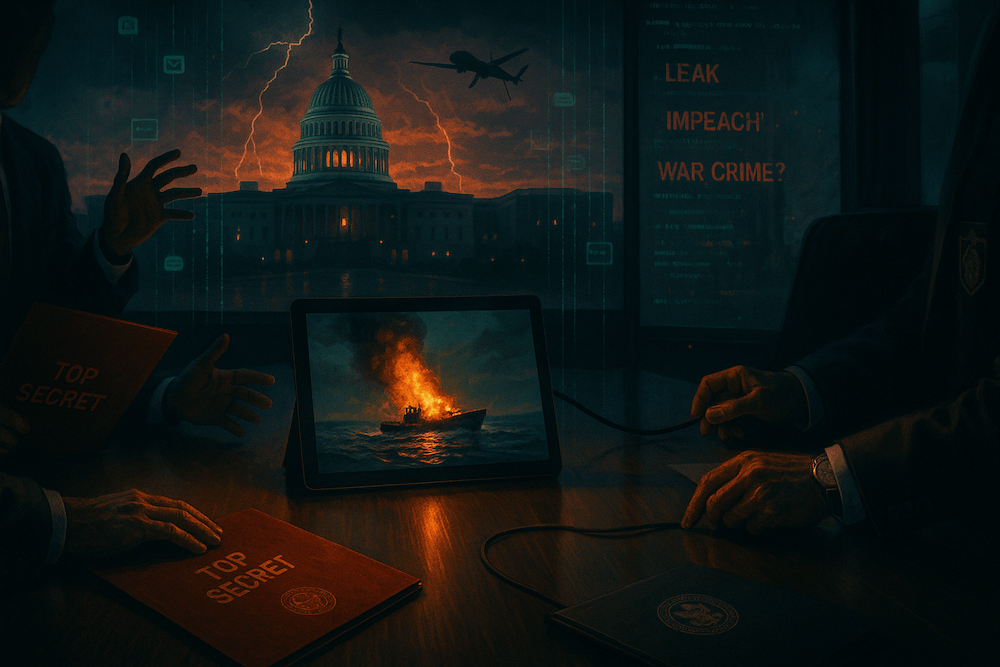
On Sept. 2, 2025, the U.S. military unleashed a deadly strike on a small boat in the Caribbean Sea — a vessel Trump’s administration claimed was ferrying illicit drugs to the United States.
According to the first account of events that day, the strike, ordered under the leadership of Pete Hegseth, reportedly left 11 people dead.
But controllers on a live drone feed saw two survivors clinging to the burning wreckage, and the mission pivoted sharply — perhaps ominously.
Rather than rescue or detain the survivors, a second missile strike — carried out by elite forces operating under Adm. Frank M. Bradley — was allegedly a direct fulfillment of Hegseth’s verbal directive: “Kill everybody.”
Fast forward to early October, when top Republican and Democratic lawmakers were summoned to a classified briefing meant to shed light on the campaign.
But Defense Department officials, according to anonymous sources, couldn’t support the legal basis for attacking civilian vessels, nor could they clearly lay out the strategy, scope or rules of engagement for the boat-strike campaign.
Legal experts, however, immediately branded the September mission potentially murder, possibly a war crime.
The survivors, they say, were not aboard a vessel and were no longer a threat; instead, they were defenseless persons in the water. Under U.S. and international law of armed conflict, killing shipwrecked or incapacitated individuals is prohibited.
The fallout was immediate. Both the House and Senate Armed Services Committees launched separate inquiries — possibly the most aggressive oversight yet aimed at Hegseth.
For some Republicans, the second-strike revelation was a bridge too far, and confidence in the secretary began to erode.
Your Rundown for Friday, December 5, 2025...
Signalgate… And a Counter-Narrative Emerges
As Congress pressed for answers, a second scandal erupted: the release of a watchdog report by the Department of Defense Office of Inspector General (IG).
The report found that Hegseth, in March, used the encrypted messaging app Signal on his personal phone to pass along sensitive information about an upcoming airstrike in Yemen, including the timing and number of aircraft involved.
That information landed in a group chat with other senior officials. And, by mistake, the editor-in-chief of The Atlantic.
Hegseth defended his actions, maintaining he had the authority to declassify the information before sharing it.
This month, the IG’s unclassified report concluded Hegseth “created a risk to operational security” but did have legal authority to declassify information as he saw fit. It’s, at least, a partial vindication for Hegseth.
Within a matter of days, we note, the Pentagon found itself enmeshed in two overlapping scandals — one rooted in alleged war crimes at sea, another in operational security failures on land.
Not everyone accepts those scandals at face value…
Paradigm editor and retired U.S. Navy officer Byron King argues what’s unfolding looks less like accountability and more like sabotage.
“The permanent-state crowd — D.C. insiders — have resisted Hegseth from the very beginning,” Byron says. “He’s Trump’s guy, which is cardinal sin No. 1. And he’s an aggressive Army officer with combat experience, which means he’s not impressed by the brass and bureaucrats who think they ought to run things.”
Byron believes both controversies — the Venezuelan boat strike and Signalgate — are “ops” engineered to discredit Hegseth and, by extension, Trump himself.
“Signalgate was a setup,” he says. “Slip an Atlantic reporter onto a call, then turn it into a breach-of-secrets scandal. Sure, bad staff work not to know who’s on the line. But at root, it was an operation to embarrass Hegseth and run him off.
“And Boatgate?” Byron adds. “There’s no way a Secretary of Defense is involved in tactical kill-box decisions. That’s the commander in the field. Fog of war. Sound and fury of battle. This is another D.C. maneuver to get rid of Hegseth and kneecap Trump.”
His bottom line: Washington’s permanent bureaucracy is waging a slow-motion coup against its own chain of command.
And Byron insists there’s a deeper layer to all this — and it runs through Venezuela.
“There are deep strategic reasons for the U.S. to increase its influence there — oil, minerals, China, Russia, communism in South America, Cuba, drugs, illegal immigration… The list is long,” he says.
“Trump can’t afford to blink here,” says Byron. “If the ships sail away and Maduro stays, it’s Trump’s Bay of Pigs.”
For Byron, the Hegseth leaks and investigations aren’t just about Pentagon protocol — they’re about whether the U.S. reasserts dominance in its own hemisphere or retreats under pressure.
Inside Republican ranks, the unity once surrounding Hegseth is splintering. Old-guard conservatives like Sen. Roger Wicker are demanding subpoenas and footage. The MAGA flank insists Hegseth is being punished for doing what Democrats never had the nerve to do — take the gloves off.
But every new headline makes Hegseth harder to defend.
The result: open civil war within the GOP.
And Democrats smell blood. Several members of the House Armed Services and Oversight Committees are reportedly drafting a resolution to impeach Hegseth.
It’s a largely symbolic gesture, but one designed to force Republicans to pick a side — the Secretary of War, the rule of law… or an orchestrated opp.
Market Rundown for Friday, December 5, 2025
S&P 500 futures are up 0.10% to 6,875.
Oil’s down 0.10% to $59.60 for a barrel of WTI.
Gold is up 0.40% to $4,261.20 per ounce.
And Bitcoin is down 1.60% to $90,820.

Rickards: Mullahs and Midterms
Posted March 11, 2026
By Matt Insley

The 401(k)-Shaped Economy
Posted March 09, 2026
By Matt Insley

All For It, Dead Against It, Deeply Uneasy
Posted March 06, 2026
By Matt Insley

MTG vs. AOC
Posted March 04, 2026
By Matt Insley

The First 72 Hours: Ayatollah Is Dead
Posted March 02, 2026
By Matt Insley
