Posted July 29, 2026

By Emily Clancy
Jim Rickards: Anthony Fauci Testifies Today – Under Oath
[In today’s guest essay, Emily Clancy — Executive Managing Editor at Jim Rickards’ Strategic Intelligence — examines the hearing that could reopen one of the most contentious chapters of the pandemic.]
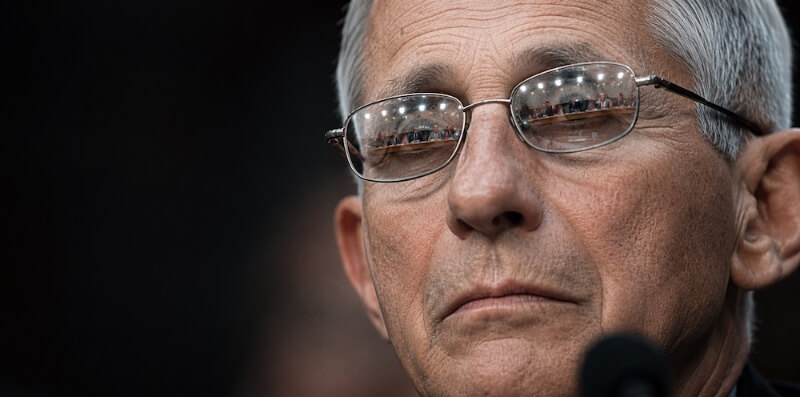
This morning, Dr. Anthony Fauci returns to Capitol Hill under subpoena to testify before the Senate Homeland Security and Governmental Affairs Committee.
Armed with newly declassified intelligence records, portions of Fauci’s pandemic-era diary and a sweeping presidential pardon hanging over the proceedings, Sen. Rand Paul believes today’s hearing could be unlike any of the previous confrontations with the former public-health official.
To understand what's at stake today, we have to go back more than four decades.
The other night, in fact, I stumbled upon an old Geraldo Rivera documentary on YouTube.
And I mean old Geraldo — before the empty Al Capone vault and the sleazy daytime talk show.
This was Geraldo Rivera in 1983, investigating a frightening new disease called AIDS for ABC’s “20/20.” At the time, much of the national media had barely acknowledged the epidemic.
Rivera interviewed dying patients, activists and government researchers. Which is when a remarkably young Dr. Anthony Fauci appeared on the screen.
Fauci was not yet the country’s most recognizable public-health official. He was a chief researcher at the National Institute of Allergy and Infectious Diseases — part of the National Institutes of Health — warning about a mysterious immune disorder and pressing for a stronger federal response.
Watching it more than four decades later was jarring.
Rivera and Fauci were both young, serious and seemingly determined to shake powerful institutions awake. Each would eventually become a television personality almost as much as a journalist or physician.
Their careers followed different paths, of course. But both stories raise the same question: What happens when public service, media attention and personal celebrity become impossible to separate?
Your Rundown for Wednesday, July 29, 2026...
Fauci’s Reckoning: “A Full Public Accounting”
Fauci’s early work on AIDS remains an important part of his record.
He became director of NIAID in 1984 and later helped reshape the government’s approach to HIV drug trials. President George W. Bush awarded him the Presidential Medal of Freedom in 2008 for his contributions to PEPFAR, the global AIDS-relief program.
That history matters.
It also helps explain how Fauci accumulated extraordinary institutional authority. By the time COVID-19 reached the United States in 2020, he had served under six presidents and led NIAID for more than 35 years.
He was no longer simply advising the government. To millions of Americans, he appeared to speak for science itself.
That perception made every subsequent decision more consequential.
Reasonable people can disagree over what officials knew at each stage of a fast-moving emergency in 2020. They were confronting an unfamiliar virus, incomplete information and genuine fear.
But uncertainty does not excuse evasion.
Nor does it erase the enormous costs of the policies Fauci defended: lost schooling, shuttered businesses and a deep collapse in public trust.
As Paradigm macro expert Jim Rickards puts it: “Everything Americans were forced to endure during the pandemic — experimental mRNA vaccines, mask mandates, social distancing, lockdowns, job losses for those who refused vaccination, lost schooling that cannot be made up and much more — flowed from decisions made by government officials who claimed they were following ‘the science.’
“Those decisions deserve a full public accounting,” Jim says.
The Paper Trail Before the Pardon
But that accounting became more complicated on Jan. 19, 2025.
In one of his final acts as president, Joe Biden granted Fauci a “full and unconditional pardon” covering potential federal offenses committed from Jan. 1, 2014, through the date of the pardon, provided they arose from Fauci’s government service.
Biden said the move was intended to protect public servants from politically motivated prosecutions and stressed that the pardon did not imply wrongdoing.
The pardon was sweeping. But it was not lifetime immunity.
It cannot protect Fauci from federal offenses committed after Jan. 19, 2025.
That detail is important this morning.
Ahead of today’s hearing, Sen. Rand Paul released portions of Fauci’s pandemic-era diary.
Fauci’s diary may help investigators establish how much he knew about an effort to keep pandemic communications away from public scrutiny.
One entry from April 2021 identifies David Morens, Fauci’s longtime senior adviser at NIAID, as someone who was privately updating him about attempts to link Fauci to the Wuhan laboratory.
That matters because Morens has since been accused of deliberately moving sensitive government communications onto personal email accounts so the messages would not be captured by Freedom of Information Act requests.
Federal prosecutors allege that Morens concealed or destroyed records involving U.S.-funded coronavirus research, the Wuhan Institute of Virology and the debate over whether COVID-19 escaped from a laboratory.
Morens was indicted in April on charges including conspiracy against the United States and the destruction, alteration or concealment of federal records. He has pleaded not guilty and the charges remain allegations.
A second set of records raises another question.
Documents declassified by outgoing Director of National Intelligence Tulsi Gabbard show the intelligence community considered consulting Fauci during its 2021 review of COVID's origins and sought his recommendations for outside scientists to interview.
Fauci recommended scientists intelligence officials could interview, including authors of an influential paper supporting a natural origin of the virus rather than researchers who had expressed openness to the Wuhan “lab leak” theory.
These same officials considered asking Fauci to review their findings but ultimately decided against it, concluding that his leadership role at NIAID and his public statements on the virus's origins could create the appearance of a conflict of interest.
Again, the documents do not establish that Fauci dictated the intelligence community’s final assessment. They do show, however, that his involvement was more substantial than the passive, arms-length role many Americans may have assumed he played.
The Fifth Amendment Dilemma
But the biggest development may not be the documents themselves. It may be Biden’s pardon.
Jim Rickards, an attorney who has personally met Sen. Rand Paul, believes today’s confrontation has been years in the making.
“Rand is a doctor. He has excellent staff,” Jim tells me. “He knew from the start that the pandemic virus was made in the lab and that research was funded by Fauci.”
Jim says he reached the same conclusion while researching for his 2021 book, The New Great Depression.
Jim also believes the newly declassified records give Paul documentary evidence he lacked during his previous confrontations with Fauci.
“Now Rand has the smoking gun and Fauci is back for the showdown,” Jim says. “Again, he’ll be under oath.”
But the legal dynamic is irregular.
Biden’s pardon protects Fauci from federal prosecution for covered conduct occurring before Jan. 20, 2025.
And because Biden’s pardon largely eliminates the risk of federal prosecution, it may also limit Fauci’s ability to invoke the Fifth Amendment which protects against self-incrimination.
(That said, Fifth Amendment privilege is determined question by question and could still apply if an answer might expose Fauci to an offense outside the pardon’s scope.)
It does not, however, protect him from crimes committed after the pardon.
And if Fauci knowingly gives materially false testimony today, that statement would constitute new conduct outside Biden’s protection.
That is what Jim considers Senator Paul’s trap.
If Fauci changes his previous account, Paul can argue that his earlier testimony was unreliable. If he stands by it, Paul can test that testimony against documents that were not publicly available during their previous confrontations.
“If he lies, that’s a new crime and not covered by the pardon,” Jim says.
Fauci’s defenders, meanwhile, say this investigation is political harassment. More than 155 scientists, physicians and public-health advocates signed an open letter this week arguing that accusations against him lack credible evidence and have fueled threats against scientists.
But a congressional subpoena is not a conviction. Asking Fauci to reconcile his sworn statements with newly released records is not an attack on science.
Today, Fauci will walk into the hearing protected from prosecution for covered conduct before Jan. 20, 2025.
What Fauci says after taking his seat is another matter.
Breaking China’s Grip in Minnesota
Posted September 21, 2026
By Matt Insley

Wednesday’s OTHER D.C. Vote
Posted September 18, 2026
By Matt Insley

Six Years of Inflation, Measured in Silver
Posted September 16, 2026
By Matt Insley

Qatar’s Great NatGas Reversal
Posted September 14, 2026
By Matt Insley

California’s Unions Turn on Each Other
Posted September 11, 2026
By Matt Insley
