Posted August 05, 2026

By Matt Insley
Missiles & Misery
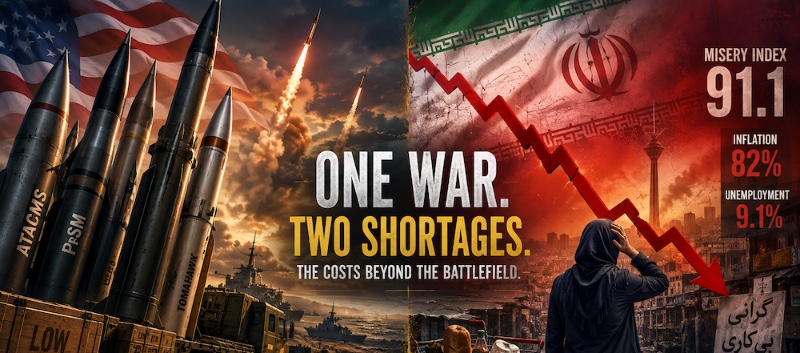
After five months of war with Iran, Reuters reports the U.S. military has burned through “virtually all” of its Army Tactical Missile Systems (ATACMS) and newer Precision Strike Missiles (PrSM).
The Pentagon has also used nearly half of its global inventory of Tomahawk cruise missiles.
Meanwhile, inside Iran, the economic damage mounts.
According to data published by the Statistical Center of Iran, the country's Misery Index — which combines the inflation rate and unemployment rate — has climbed to a record 91.1, the highest level ever recorded.
Those two emergencies tell different stories about the same conflict.
One side is consuming weapons faster than industry can replace them. The other is watching its economy buckle under the weight of war, inflation and unemployment.
Both carry consequences that extend well beyond the battlefield.
Send your opinions to, feedback@newsyoucanacton.com
Your Rundown for Wednesday, August 5, 2026...
The Factory Floor Offensive
After months of sustained operations across the Middle East, Reuters reports that U.S. stocks of long-range precision weapons have fallen to dangerously low levels.
These missiles are among America’s most valuable conventional weapons, designed to strike heavily defended targets from hundreds of miles away without putting pilots at risk.
Their depletion also underscores one of modern warfare’s biggest lessons.
Wars are no longer won simply by possessing advanced weapons. They’re won by maintaining the industrial capacity to keep producing them.
That lesson has repeated over the past several years, from Ukraine to the Red Sea to the Iran conflict. Precision-guided missiles, drones and interceptor systems are being consumed at rates few military planners anticipated.
President Trump downplayed concerns Tuesday, saying the U.S. has “far more munitions than anyone in the world” and that defense manufacturers are “making more munitions than they have ever made before,” while expanding production capacity at record levels.
Still, replenishing sophisticated missile inventories isn’t as simple as flipping a switch. Many require specialized propulsion systems, advanced electronics and complex supply chains that can take months — or years — to rebuild.
Iran faces a different kind of crisis.
The country’s economy is deteriorating at an astonishing pace.
- According to the Statistical Center of Iran, consumer prices were 82% higher this spring than they were a year earlier, while unemployment climbed to 9.1%, pushing the country’s Misery Index up nearly 17 points in just one quarter — and almost double the level recorded a year ago.
An economy under that kind of strain can become a strategic liability.
History shows governments fighting expensive wars often face growing domestic pressure as inflation erodes purchasing power and unemployment rises.
Whether that ultimately changes Tehran’s military calculus remains an open question, but the economic burden is becoming increasingly difficult to ignore.
The latest conflict is also accelerating broader changes in warfare.
Cheap drones continue forcing militaries to expend million-dollar interceptors. Electronic warfare is becoming just as important as firepower.
Artificial intelligence is helping drones navigate, identify targets and coordinate attacks with minimal human input. And industrial production — not battlefield tactics — is determining which countries can sustain a prolonged conflict.
For investors, that’s an important distinction.The next phase of the defense story may have less to do with battlefield victories than factory output.
Companies that manufacture missiles, propulsion systems, precision guidance electronics, rocket motors and counter-drone technologies could remain in focus as governments replenish depleted arsenals.
The race isn’t simply to build more weapons. It’s to rebuild the industrial base capable of producing them fast enough to be battle ready.
Market Rundown for Wednesday, August 5, 2026
S&P 500 futures are up 0.50% to 7,800.
Oil’s up 0.40% to $76.05 for a barrel of West Texas Intermediate.
Gold is up 2.85% to $4,271.40 per ounce.
And Bitcoin’s up 0.20% to $64,370.

Bitcoin, Bessent and a $40 Trillion Time Bomb
Posted August 24, 2026
By Matt Insley

120,000 Socialists Have a Plan
Posted August 21, 2026
By Matt Insley

Trump Claims Deed to Hormuz
Posted August 19, 2026
By Matt Insley
Airfares Up 25%
Posted August 17, 2026
By Byron King

AOC Wants a Do-Over
Posted August 14, 2026
By Matt Insley
