Posted December 10, 2025

By Matt Insley
Obamacare Expiration
If you think about what voters care about most these days — everyday costs, household budgets — health care is right at the top.
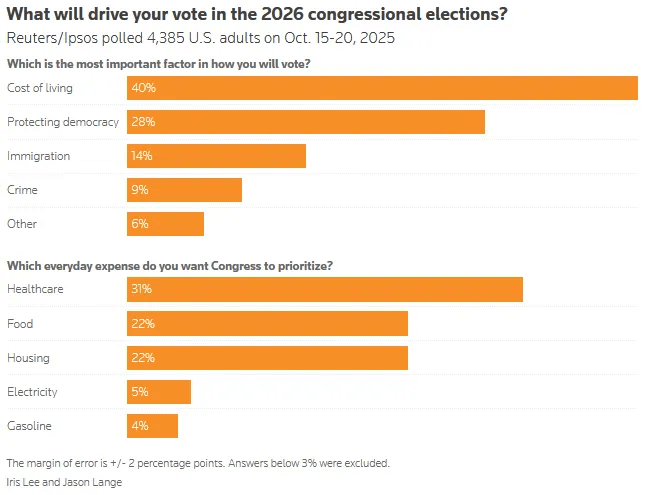
Source: Reuters/Ipsos
Given that backdrop, health care could become the issue of the 2026 midterms. And historically, when health care is front-and-center, Democrats tend to succeed.
The catalyst: the expanded Affordable Care Act (ACA) premium tax credits are set to expire at the end of 2025, reverting back to original rules.
Without any legislative extension, millions of Americans will suddenly face sharply higher monthly premiums.
That shift will hit at a politically sensitive moment — the midterm cycle when many Americans are already financially squeezed and evaluating which party offers relief.
Your Rundown for Wednesday, December 10, 2025...
Countdown to a Health-care Crisis
Under the enhanced system (2021–2025), the law expanded who qualified for tax credits — making premiums more affordable for middle-income households that previously wouldn’t have qualified.
There is still a legislative window for Congress to preserve (or reshape) the subsidies, if it acts before the end of the year. But if Congress does nothing, ACA enhancements disappear January 1, 2026.
Projections are stark. According to the Kaiser Family Foundation (KFF), for instance, the typical Marketplace enrollee’s annual premium payment would jump about 114% compared with 2025
For people already stretching to pay premiums or medical bills — older adults, moderate-income families, gig workers, people who buy their own insurance — the loss could be crippling.
Even among those who keep coverage, many express deep concern. Per KFF’s 2025 survey of ACA Marketplace enrollees: About 60% say it’s difficult to afford out-of-pocket costs, and half say they already struggle with premiums each month.
Worse, a sizable portion say if premiums rise further, they might drop coverage. One estimate suggests up to 4 million Americans could go uninsured.
Many of those affected by rising costs are working-class or middle-income people, older adults, or families — groups that tend to respond strongly when policies hit their wallets.
Politically, this sets up a dramatic contrast: Republicans have largely opposed continuing the enhanced ACA subsidies, arguing they are expensive and inefficient.
Democrats, on the other hand, are pushing hard to extend the subsidies, casting Republicans as out of touch with ordinary Americans’ cost pressures.
That debate could shift public attention squarely onto health care, making it not just one issue among many, but the issue — especially if premiums spike and people begin losing coverage or cutting other necessities just to afford insurance.
For many voters, the question will be immediate and personal: Will I be able to afford health care next year?
If the answer is no, those voters are likely to lean toward the party promising relief.
Market Rundown for Wednesday, December 10, 2025
S&P 500 futures are slightly in the red at 6,845.
Oil’s up 0.30% to $58.40 for a barrel of WTI.
Gold is down 0.25% to $4,225.90 per ounce.
Bitcoin’s down 1% to $92,170 this morning.

Rickards: Mullahs and Midterms
Posted March 11, 2026
By Matt Insley

The 401(k)-Shaped Economy
Posted March 09, 2026
By Matt Insley

All For It, Dead Against It, Deeply Uneasy
Posted March 06, 2026
By Matt Insley

MTG vs. AOC
Posted March 04, 2026
By Matt Insley

The First 72 Hours: Ayatollah Is Dead
Posted March 02, 2026
By Matt Insley
