Posted May 22, 2026

By Mason Sexton
The Reagans’ Secret Advisor
[Editor’s note: We wanted to share a fascinating guest essay from our colleague Mason Sexton.
Mason traces a hidden thread running from ancient rulers… to Wall Street traders… to the Reagan White House itself: the belief that cycles, timing and mass psychology shapes history more than most people realize.]
They called me “The Moonman.”
The nickname came from Phoebe Zaslove, one of the first female partners at Morgan Stanley, back when she ran the firm’s options desk in the 1980s.
At the time, I was advising institutional clients using a form of cycle analysis that included lunar and planetary patterns alongside more traditional market work. Even on Wall Street, where people publicly dismiss anything that sounds unconventional, the results were difficult to ignore.
In early 1985, my research projected that the stock market was heading into what could become the biggest rally in modern history.
That forecast proved correct.
The Dow Jones exploded higher into 1987, climbing from 1,908 to more than 2,700 in less than two years. But the more important call came later…
In an August 1987 CNN interview, I warned that the market was nearing a major top and projected that a devastating correction would follow later that autumn.
The market peaked almost precisely in the timing window I gave.
Weeks later came Black Monday.
On October 19, 1987, the Dow Jones suffered the worst one-day percentage collapse in its history.
Before the crash, I advised clients to exit stocks and buy protective puts. That work eventually brought me into conversations with some of the largest private banks in Europe and institutional investors around the world.
The methodology behind those calls was rooted in cycles.
One of the cycles I tracked closely was the lunar cycle. Hence the nickname “The Moonman.”
Now, if you’re skeptical, I understand. Most people hear the word astrology and think of newspaper horoscopes or internet personality quizzes.
That’s not what I’m talking about.
What I study are recurring cycles — the same kinds of cycles humanity has tracked for thousands of years in weather, agriculture, economics, politics and human behavior itself.
Markets, after all, are ultimately expressions of mass psychology. Fear and euphoria move in patterns. History often does too.
Civilizations have tracked these rhythms for thousands of years.
Farmers tracked the sky to know when to plant. Sailors tracked it to navigate oceans. Ancient rulers tracked it before wars, coronations and major political decisions.
The sky was humanity’s first clock.
That idea — and the strange persistence of it throughout history — eventually became the foundation for my book, Stargazers & Kings.
What began for me as market cycle research slowly expanded into a historical investigation into how rulers, financiers, strategists and political elites quietly used timing, cycles and celestial patterns to navigate periods of uncertainty.
Somewhere along the way, modern society decided that was all primitive superstition. And to be fair, a lot of what passes for astrology today deserves the ridicule it gets.
But the study of timing, cycles and recurring patterns — and the way human psychology appears to move in recognizable waves over long periods of time — is more important than you may think.
Markets themselves are emotional organisms. Greed, fear, panic and optimism don’t emerge randomly. They cluster, intensify and repeat.
And after decades of studying cycles, I began to notice that some of the same periods that produced financial extremes also coincided with political upheaval, war, leadership crises and even periods of heightened geological instability.
That’s when my work expanded beyond markets alone…
Your Rundown for Friday, May 22, 2026...
Stargazers & Kings
In recent years, I used the same cycle analysis to identify heightened risk windows surrounding the escalation with Iran, periods of unusual political instability in the United States and even elevated risk periods involving President Trump long before the latest assassination attempt occurred.
I’m far from the first person to study the world this way.
Long before modern economics existed, ancient civilizations tracked cycles in the sky as a way of understanding cycles on Earth.
Most people assume these practices disappeared with the ancient world, but they didn’t.
One of the most remarkable modern examples came during the Reagan administration.
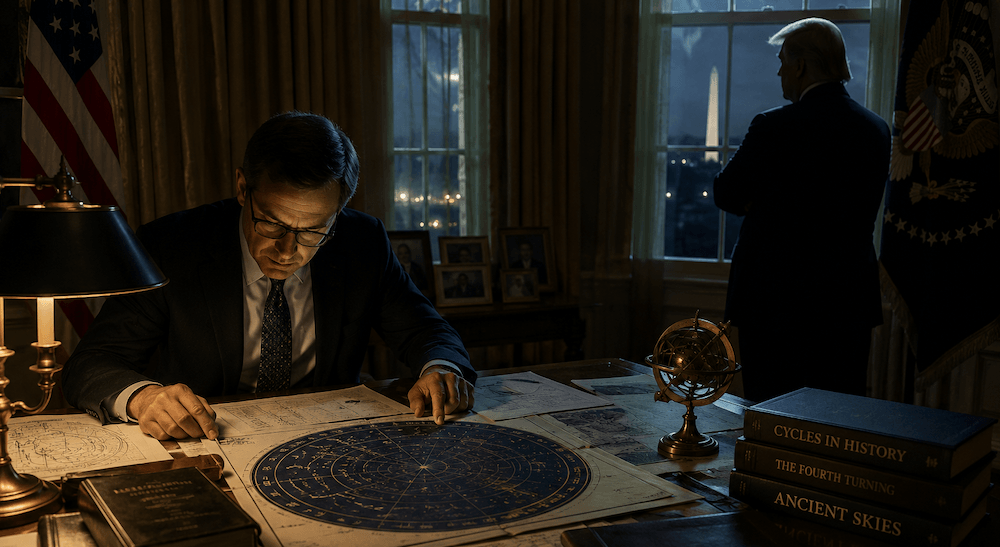
After the 1981 assassination attempt against President Reagan, First Lady Nancy Reagan quietly began consulting astrologer Joan Quigley to help assess periods of heightened risk surrounding the President’s schedule and public appearances. Over time, that relationship became deeply embedded within the White House scheduling apparatus itself.
This wasn’t rumor or internet mythology. It was later confirmed publicly by Reagan’s own Chief of Staff, Donald Regan, who wrote:
“Virtually every major move and decision the Reagans made during my time as White House Chief of Staff was cleared in advance with a woman in San Francisco who drew up horoscopes.”
According to accounts from inside the administration, Quigley used a color-coded calendar system to identify favorable and unfavorable timing windows for everything from presidential travel to diplomatic meetings to major political events.
The important thing is that serious people at the highest levels of power clearly believed timing mattered enough to quietly incorporate these methods into the decision-making process of the White House itself.
Important diplomatic meetings were timed around astrological windows. Presidential surgery timing reportedly passed through the same filter. Even summit meetings with Soviet leader Mikhail Gorbachev were analyzed through this lens.
Astrology was not replacing political decision-making. Instead, it was being used as a timing mechanism.
Whether one ultimately believes Quigley’s methods worked exactly as intended is secondary to the larger historical point…
At the height of the Cold War, inside the most powerful government on Earth, timing and cycles were taken seriously enough to influence the President’s schedule.
That, ultimately, is the real subject of my book, Stargazers & Kings.
The Babylonian sky watchers tracked celestial movements alongside the fate of kingdoms. Then, thousands of years later, the same instinct resurfaced in the Reagan White House during the Cold War.
The institutions changed. Human nature did not.
Even today, the language is still with us, only modernized.
Central banks study long-term economic cycles. Hedge funds employ behavioral analysts and geopolitical forecasters. Governments monitor sentiment trends, social instability and historical analogs. Investors obsess over patterns, timing and probability models.
All of it, in one form or another, is an attempt to solve the same ancient problem:
How do you navigate uncertainty before events fully reveal themselves?
My book, Stargazers & Kings, is a historical examination of how those in power have always tried to understand the rhythm of history itself.
Again and again, rulers have searched for advisors who could identify turning points before the rest of society recognized them.
Even on Wall Street, that instinct never fully disappeared. J.P. Morgan himself famously remarked that millionaires don’t use astrology, billionaires do. Behind the scenes, elite financiers studied cycles, timing and mass psychology in ways the public rarely saw.
Most people only recognize the pattern after the turning point has already arrived.
This book is about the people who tried to recognize it before everyone else did.
Stargazers & Kings is available now. Click here to get your copy.
Warsh's Shrinking Inflation Options
Posted June 12, 2026
By Matt Insley

James Altucher: The Truth About SpaceX
Posted June 10, 2026
By Matt Insley

Who Is the Next Elon?
Posted June 08, 2026
By Matt Insley

Platner’s Moment of Truth
Posted June 05, 2026
By Matt Insley
Do Americans Still Believe in America?
Posted June 03, 2026
By Matt Insley