Posted January 26, 2026

By Matt Insley
Trump Puts Allies on Notice
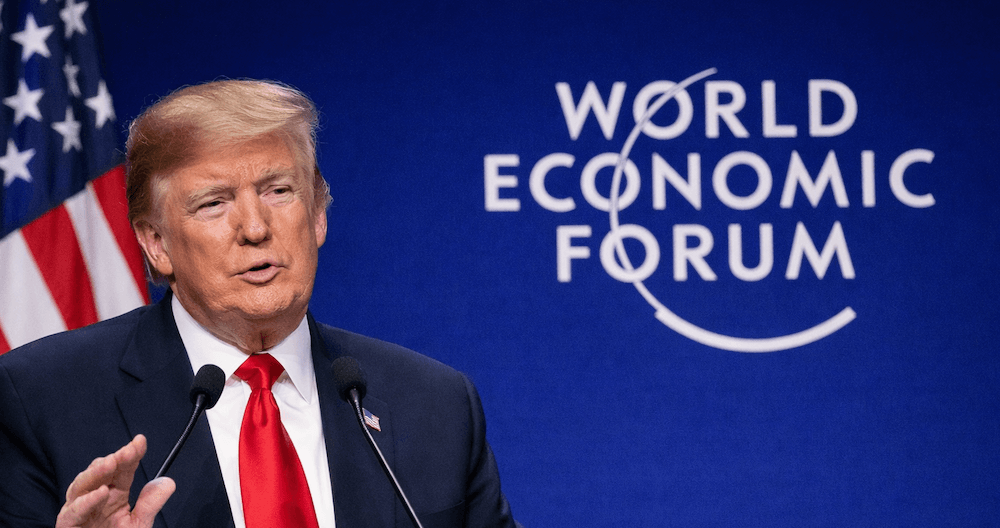
If Davos is supposed to be the place where global elites speak measuredly and hedge everything, Donald Trump didn’t get the memo.
His special address at the World Economic Forum last week ran more than an hour and felt less like a policy speech than a reminder of how differently he operates from the people who usually dominate that stage.
Trump covered a lot of ground — tariffs, Greenland, NATO spending, wind energy — but what stood out wasn’t any single policy line. It was the contrast he injected into a conference already split down the middle.
Because this year, the World Economic Forum (WEF) really did feel like two conferences running side by side.
In one version, executives and investors were upbeat. Artificial intelligence has moved past hype and into deployment. Conversations revolved around “physical AI,” automation and the sheer volume of capital waiting to be put to work.
In the other Davos, the one Trump walked into, the dominant themes were tariffs, trade leverage and whether the rules that have governed global markets for decades still apply.
Trump didn’t try to reconcile those two worlds. He widened the gap.
Your Rundown for Monday, January 26, 2026...
Trump Puts Allies on Notice
Inside the Congress Hall, the atmosphere felt closer to a rally than a roundtable. People queued for over an hour. There was laughter early on — particularly when Trump riffed on French President Emmanuel Macron’s appearance the day before.
“I watched him yesterday with his beautiful sunglasses,” Trump said, prompting chuckles. “What the hell happened?”
But you could hear a pin drop when Trump turned serious.
He again raised the idea of the United States acquiring Greenland — insisting it was a strategic necessity — and while that position wasn’t new, the delivery landed differently in Davos.
Investors who had been talking about AI infrastructure a few hours earlier were suddenly recalculating geopolitical risk.
On trade, the president backed away from tariffs on European countries and ruled out using force to take Greenland, but he had little patience for allies he believes are riding American coattails.
Spain, for instance, came under renewed fire for defense spending. NATO members agreed last year to lift military spending toward 5% of GDP by 2035, but Spain secured an exemption to remain around 2%. “They want a free ride,” Trump said. “Every country but Spain increased to 5%.”
Canada, however, was the target of Trump’s scorn. After Prime Minister Mark Carney warned at Davos that “middle powers” must act together because “if we’re not at the table, we’re on the menu,” Trump responded.
“Canada gets a lot of freebies from us,” he said. “They should be grateful… Canada lives because of the United States. Remember that, Mark.”
Shortly after, Trump withdrew Carney’s invitation to join his proposed “Board of Peace” for Gaza — a body whose permanent members would be required to contribute $1 billion each.
[Within days of leaving Switzerland, Trump threatened to impose a 100% tariff on Canadian goods if Ottawa moved forward with a trade deal with China.]
Trump also revived a familiar critique of wind energy. “They are losers,” he said of Europe’s windmills, arguing that countries with more turbines perform worse economically.
He went further, claiming China manufactures wind turbines but avoids deploying them domestically — a point Chinese officials and European executives quickly disputed.
But China’s energy reality undercuts much of the moralizing that often follows these debates. China now burns almost 60% of all coal consumed globally, according to 2024 data from the International Energy Agency — a fact that sits uneasily alongside the lofty climate rhetoric that dominates forums like the World Economic Forum.
That imbalance — between ambition and reality, innovation and geopolitics — was already present in Davos long before Donald Trump took the stage. Trump didn’t create that tension. But he forced it into the open. And by the end of the week, that may have been the point.
Market Rundown for Monday, January 26, 2026
S&P 500 futures are barely in the red at 6,945.
Oil is down 0.15%, just under $61 for a barrel of WTI.
Gold’s up 1.75% to… $5,077.80 per ounce.
And Bitcoin’s up 1.80% to $87,810.
Make Elections Great Again
Posted February 02, 2026
By Matt Insley
How Congress Gets Rich
Posted January 30, 2026
By Matt Insley

The Great SaaS Meltdown
Posted January 23, 2026
By Matt Insley

Greenland, Inc.
Posted January 21, 2026
By Matt Insley

Texas-to-California Pipeline Moves Forward
Posted January 19, 2026
By Matt Insley
