
Posted April 20, 2026

By Matt Insley
Uranium Diplomacy
When it comes to uranium, Iran is more self-sufficient than most people realize.
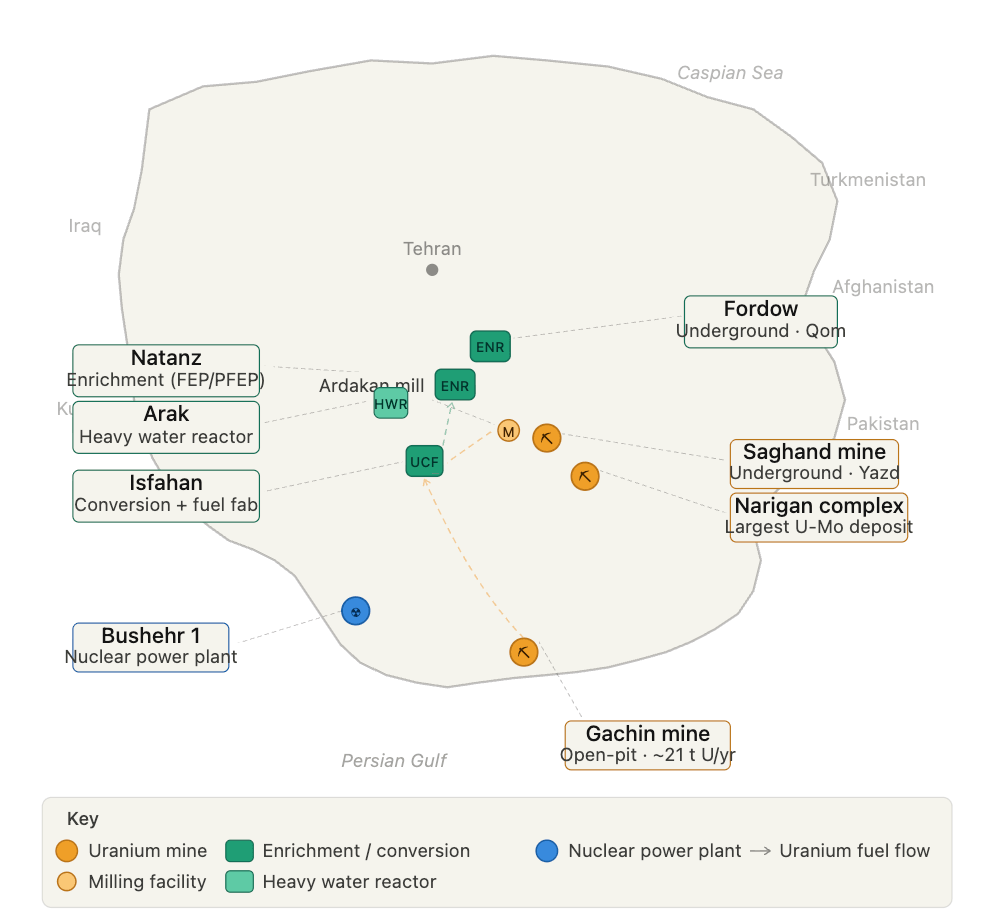
The country sits atop modest domestic reserves. Its main operating mine is at Gachin, near the Persian Gulf port of Bandar Abbas, where ore extracted from open-pit salt plugs is acid-leached to yield roughly 21 tonnes of uranium per year.
A second underground mine at Saghand, deep in the central Yazd desert, came online in 2017 and feeds the associated Ardakan mill about 47 miles to the west.
A third site — the Narigan Mining and Industrial Complex, also in Yazd province — began operations in 2023 and is Iran’s largest uranium deposit, holding an estimated 650 tonnes of uranium.
Courtesy: Claude.ai
From the mines, yellowcake — the intermediate product after an initial milling process — travels to the Isfahan Nuclear Technology Centre, where a uranium conversion facility with 200-tonne annual capacity has been operating since 2004, transforming yellowcake into uranium hexafluoride (UF6) — the gaseous feedstock for enrichment.
Isfahan also houses fuel fabrication plants for Iran’s research reactors and its sole operating power station, Bushehr 1, a Russian-built VVER-1000 on the Persian Gulf coast.
That said, domestic production alone has never been enough.
Your Rundown for Monday, April 20, 2026...
Dust, Dollars and a Three-Page Deal
In the early 1980s Iran purchased 450 tonnes of uranium from South Africa, and most of that South African material — not the ore from Iran’s own mines — is what has been feeding the enrichment cascades at Natanz and Fordow.
Iran has also sought uranium imports from Kazakhstan and received material from Russia under the terms of the 2015 nuclear deal, the JCPOA.
Enrichment itself is the crux of every argument. The process uses thousands of centrifuges spinning at extraordinary speeds to separate the rare U-235 isotope from the far more abundant U-238.
Low-enriched uranium (under 5% U-235) powers civilian reactors. Twenty percent is where international alarm bells start ringing. Ninety percent is weapons-grade.
By June 2025, Iran had accumulated roughly 440 kilograms enriched to 60% purity — a level with no credible civilian purpose.
On June 12, 2025, the International Atomic Energy Agency (IAEA) formally declared Iran in breach of its non-proliferation obligations. The following day, Israel struck over 100 targets, destroying the above-ground Natanz pilot enrichment plant.
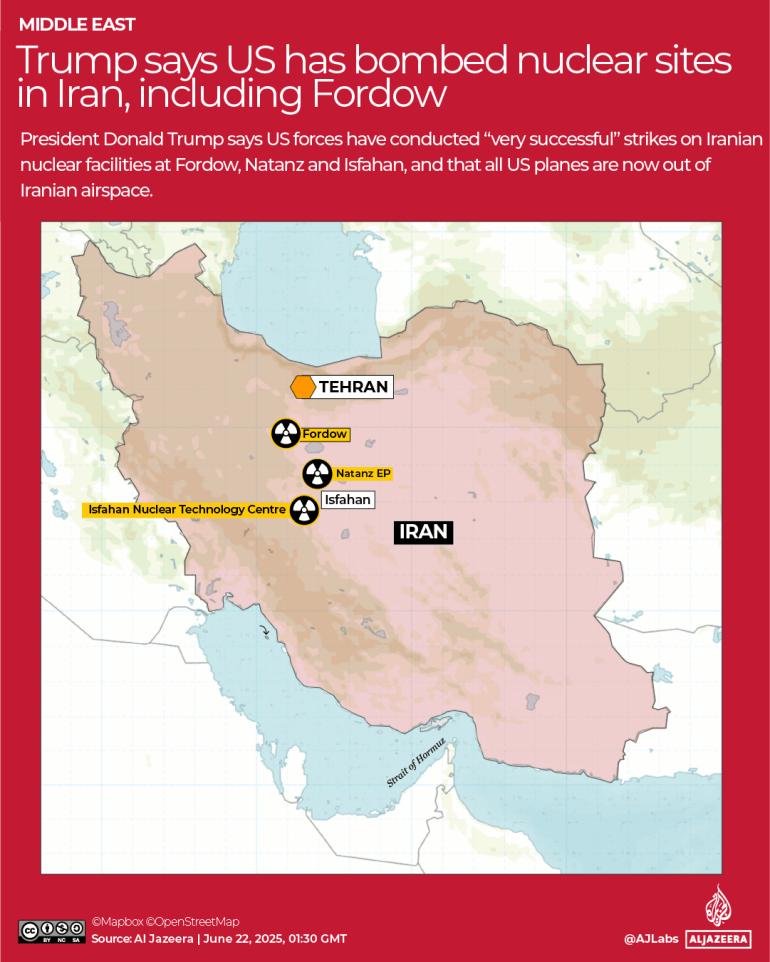
Overnight on June 21, U.S. B-2 bombers hit Fordow, Natanz and Isfahan with deep-penetrating munitions. A joint U.S.-Israeli campaign resumed on March 1, 2026, striking again at Natanz, Arak’s heavy water plant.
Source: Al Jazeera (June 22, 2025)
Now, with a two-week ceasefire expiring on April 22, 2026, the endgame is being negotiated — and it’s denominated in uranium and dollars.
According to Axios on Friday, the U.S. and Iran are discussing a three-page plan in which Washington would release $20 billion in frozen Iranian assets in exchange for Tehran surrendering its remaining enriched uranium stockpile — nearly 2,000 kilograms in total, including approximately 450 kilograms enriched to 60%.
The uranium, under the proposal, would be shipped to a third-party country, with some uranium down-blended inside Iran under international monitoring.
After the Axios story broke, Trump posted on Truth Social that the U.S. would get Iran’s nuclear “dust” but that “no money will exchange hands in any way, shape, or form.” He told reporters separately that Iran had agreed to “a very, very powerful statement” that it would never seek nuclear weapons.
Iran originally demanded $27 billion; the U.S. had previously floated $6 billion. Pakistan is mediating, with Egypt and Turkey playing supporting roles. A second round of talks is expected in Islamabad.
The differences, according to Axios sources, center on one thing: whether Iran will agree to permanently cease enrichment and give up what it spent decades and enormous treasure building.
Iran’s uranium is the story. It always has been.
[This just in: Minutes ago, Tehran announced it has “no plans” to resume negotiations in Pakistan. Time will tell.]
Market Rundown for Monday, April 20, 2026
S&P 500 futures are down 0.40% to 7,130.
Oil is up 5.30% to $88.30 for a barrel of WTI.
Gold’s down 1% to $4,827.70 per ounce.
And Bitcoin’s up 0.60% to $75,460.

Honey, They Shrunk A Data Center
Posted May 08, 2026
By Matt Insley

“Instant Berkshire” Dies on Live TV
Posted May 06, 2026
By Matt Insley

May 4 Mailbag: You Didn’t Hold Back
Posted May 04, 2026
By Matt Insley

Schumer’s Plan Backfired
Posted May 01, 2026
By Matt Insley

San Francisco Got It Right
Posted April 29, 2026
By Matt Insley
