Posted February 18, 2026

By Matt Insley
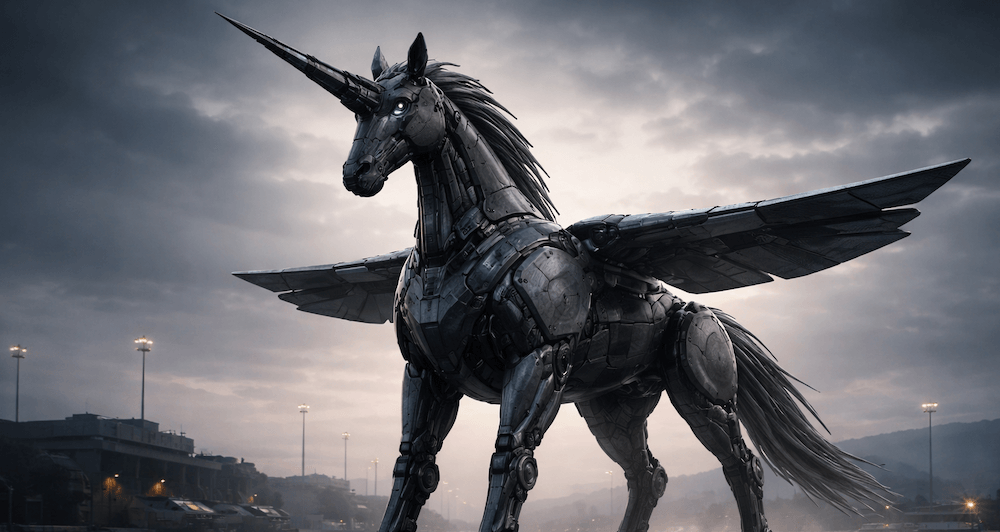
War Unicorns: Adapt or Die
There have been multiple reported cases of “non-contact surrender” in Ukraine — Russian troops communicating with or surrendering under the direction of drones and, in some instances, unmanned ground vehicles — while Ukrainian forces monitored remotely from miles away.
That image has been bouncing around my head all week. Because what happened in that grey zone mud says more about where defense spending is going than any Pentagon press release I’ve read in years.
The war in Ukraine has quietly become the world’s most expensive and consequential technology demonstration.
- Multiple analyses suggest drones are now responsible for the majority of frontline combat losses — often estimated around 70%
- According to a CSIS report, drones using autonomous navigation have demonstrated target-engagement success rates around 70–80%, compared to roughly 10–20% when systems rely heavily on manual piloting and stable communications.
The Pentagon has been watching. Army Secretary Dan Driscoll delivered what amounts to a public warning to the legacy defense giants: “They have got to adapt and change or die, and we will hold them publicly accountable if they don't.”
That’s a harder line than we're used to hearing. But Driscoll was careful to add: “It does not mean we don’t need them today.”
Lockheed Martin, RTX (formerly Raytheon) and Northrop Grumman still anchor core defense architecture — strategic aircraft, missile defense, space systems and critical subsystems that no startup can replicate in a garage. The legacy primes aren’t going anywhere.
But the Pentagon is signalling they no longer have a monopoly on the future of warfare.
Into that gap steps a new species: the war unicorn…
Your Rundown for Wednesday, February 18, 2026...
A Massive Reallocation of Defense Dollars
You know what a unicorn is — a startup worth a billion dollars. A war unicorn is the same idea, only it’s chasing Pentagon contracts.
Defense-tech startups, in fact, just had one of their biggest funding years ever, with money pouring into companies building drones, AI software and advanced manufacturing.
The flagship example is Anduril Industries — Palmer Luckey’s autonomous-systems company — which raised $2.5 billion at a $30.5 billion valuation in June 2025 and is reportedly now in talks to raise as much as $8 billion at a valuation north of $60 billion.
It’s building a defense manufacturing facility in Ohio designed to produce tens of thousands of autonomous military systems annually.
Now, here’s the news that broke Sunday and changed the calculus entirely.
SpaceX and its newly acquired AI unit, xAI, are competing in the Pentagon’s $100 million Autonomous Vehicle Orchestrator Prize Challenge — launched publicly by the Defense Innovation Unit alongside the Defense Autonomous Warfare Group.
The goal: build software that translates a battlefield commander’s intent — including spoken commands — into coordinated autonomous drone behavior. Simply say “secure that grid square,” for example. The systems move to execute.
The irony? Musk co-signed a 2015 open letter calling for limits on offensive autonomous weapons. A decade later, his companies are reportedly competing to help build the command architecture behind exactly that capability.
OpenAI, for its part, is reportedly supporting at least one competing bid by providing a voice-to-instruction translation layer — while avoiding direct involvement in targeting decisions or weapons integration.
At its core, this is a story about a massive reallocation of defense dollars.
The old contractors aren’t dead — they’re evolving or being nudged aside on specific fronts. The new players are moving fast and accumulating Pentagon credibility in real time.
Anduril remains private. SpaceX may IPO this year. But the publicly traded companies with exposure to this shift — Palantir on the AI side, AeroVironment in the small-drone supply chain and, yes, the legacy primes who are themselves investing heavily in autonomy — deserve a spot on your radar.
The battlefield is changing. The market is catching up.
Market Rundown for Wednesday, February 18, 2026
S&P 500 futures are up 0.35% to 6,885.
Oil’s up 2.50% to $63.90 for a barrel of WTI.
Gold is up 1.50% to $4,979.40 per ounce.
Bitcoin’s down 0.65% to $67,245.

Delta: We Bought a Refinery
Posted April 10, 2026
By Matt Insley

1-800-CAL-MOVE
Posted April 08, 2026
By Matt Insley

The Green New Scam Exposed
Posted April 03, 2026
By Matt Insley
Supply Chain Cracks and Crumbles
Posted April 02, 2026
By Matt Insley

AI Imprisons Innocent Woman
Posted April 01, 2026
By Matt Insley
